

Our years-long restoration of 624 White Street reached a milestone last week with the opening of our first exhibition, “Elizabeth Bishop’s Postcards,” now on display in the historic living and dining rooms of the house where celebrated American poet Elizabeth Bishop lived and wrote during the 1930s and 1940s.
The exhibition contains 71 postcards that Bishop sent to friends over the course of her well-traveled life, from places including Key West, Rio de Janeiro, and London, to correspondents including the painter Loren MacIver, Bishop’s aunt Grace Bulmer Bowers, and lovers Lota de Macedo Soares and Alice Methfessel. The exhibition is curated by Jonathan Ellis (University of Sheffield) and Susan Rosenbaum (University of Georgia) from the special collections library at Vassar College, which has the world’s largest holding of primary sources related to Bishop’s life and work. It celebrates what the curators call Bishop’s “fifth art,” adding to the widespread recognition of her poems, prose, letters, and paintings.
A pair of postcards Elizabeth Bishop sent in the late 1970s to her friend and fellow poet James Merrill (who himself was discovering Key West around that time and settling into a home on Elizabeth Street) convey the utter delightfulness of the show and validate the curators’ decision to focus on the often-overlooked medium of the postcard, which, in Bishop’s hands, becomes an opportunity to express the value and difficulties of writing, and the utility of travel.
Writing to Merrill in 1978, Bishop winks at her 1976 poem “One Art,” which, with its refrain, “The art of losing isn’t hard to master,” has become one of Bishop’s most revered works. “Dear Jimmy,” she begins, “Letter-writing seems to be my lost art – well, and so is poetry-writing, I’m afraid, or almost. There is always too much to say.” Two months later, in January 1979, Bishop writes again: “I find it much easier to work away from home than ‘at home’ for some reason. In fact, when I think about it, it seems to me I’ve rarely written anything of any value at the desk or in the room where I was supposed to be doing it — it’s always in someone else’s house, or in a bar, or standing up in the kitchen in the middle of the night.”
After debuting the show at Vassar College in Fall 2023, the curators added a new selection for the Key West installation containing eight postcards Bishop sent from Florida. The show at 624 White Street will be the final opportunity for American audiences to see the exhibition before it travels abroad for an installation at the Sorbonne in Paris next year. The exhibition is open to the public on Tuesdays, Wednesdays, and Thursdays, from 11am-2pm, through May 8, 2025. Closing events, including a talk by curators Ellis and Rosenbaum, are scheduled for April 25-26.
On view: “Elizabeth Bishop’s Postcards”
Regular Hours: Tues–Weds–Thur, 11am–2pm
Through May 8, 2025
Opening Events: April 25–26
Friday April 25
4–6 pm: Opening Reception
6–7:15 pm: Curators Jonathan Ellis and Susan Rosenbaum discuss Bishop’s postcards, her “fifth art.” With remarks by Ronald Patkus, Vassar College’s Head of Special Collections; and KWLS executive director Arlo Haskell.
Saturday April 26
9:30–10 am: Poetry reading by Key West Poet Laureate Emily Schulten
10–10:30 am: The Letters of Elizabeth Bishop and Marianne Moore. Dr. Heather White in conversation with Arlo Haskell.
10:30 am–3:30 pm: Exhibition open to the public
Where: 624 White Street, Key West
In partnership with Vassar College, University of Georgia, and University of Sheffield.
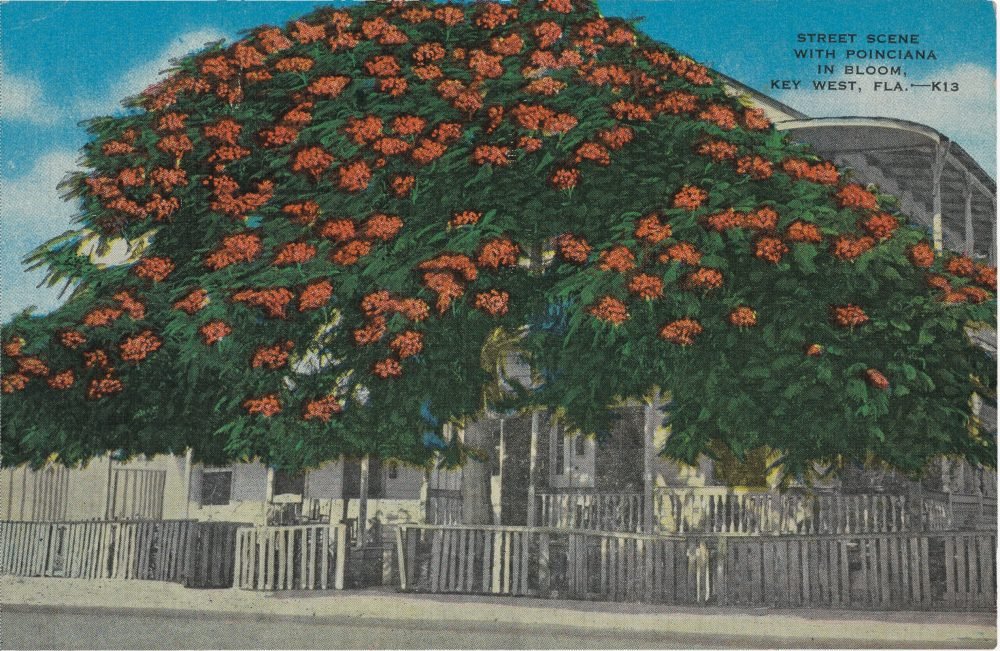
Images at top: (1 and 2) “Street Scene with Poinciana in Bloom, Key West, Fla.” Postcard from Elizabeth Bishop to Florence Bishop, September 7, 1957. Elizabeth Bishop Papers, Vassar College. (3, 4, and 5) Exhibition photos from 624 White St.

Norman Van Aken says:
The second house I lived in during my Key West years was at 524 White Street. The home is still there. I visited the Bishop home not too long ago. I am very happy to know that you all have done this amazing restoration to share Ms. Bishop’s legacy with new generations. Best, Norman Van Aken