September is here, but Key West’s summer is at its peak — think booming thunderstorms, streets full of puddles, and trees in all the beautiful shades of green.

Back in June, a terrific group of local high school students participated in our Young Writers Studio. Now we’re expanding our educational program to serve elementary-age students as well, following a busy summer of curriculum development. When our new Field Studies initiative begins next week, students will begin to use the Elizabeth Bishop House & Garden as their campus and classroom for activities that engage the senses and to practice the observational skills that are the building blocks of good writing.

We’re proud of the work we’ve done at the Bishop House, and delighted that others are noticing it, too. We recently earned preservation awards from the Historic Florida Keys Foundation and the Florida Trust for Historic Preservation. The Bishop House and our work to activate it for young writers were also recently featured in the New York Times and in Preservation Magazine.

We’re even more proud of our alumni and all their incredible accomplishments since our last newsletter. Read on to see why. Congratulations to all!

Support local & independent booksellers! Purchase any book highlighted here from Books & Books @ The Studios of Key West and get a 20% discount. Use code “KWLS27” at checkout.

featured achievements

Dr. Corinthia Price, a 2026 Teacher & Librarian Scholarship winner, was elected president of the International Association of School Librarianship (IASL). With members across the globe, IASL provides an international forum for people interested in promoting effective school library programs as viable instruments in the educational process. As IASL President, Dr. Price will champion the vital role of school libraries worldwide, spearhead global literacy initiatives, and lead IASL’s executive board, regional directors, and special interest groups into a new era of cross-cultural collaboration. (2026)

emerging writer award winners

Melanie Pappadis Faranello‘s essays have recently appeared in Hippocampus and How We Spend Our Days, and a story from her debut collection, Everybody Needs Something, was re-published in Failbetter. She also launched The Community Poem Project, an online collaborative poem that will become part of a public art exhibit. (2022)

Ricardo Zegri won the Katharine Bakeless Nason Participant Scholarship in Nonfiction for the 2026 Bread Loaf Writers’ Conference and is hard at work on the third draft of his full-length memoir. (2025)

writers in residence

Rachel Beanland‘s novel The Half Life was published by Simon & Schuster in July. The novel is set in Sardinia in the 1970s and follows a woman forced to choose between devotion to her new husband and loyalty to a group of Italian scientists and activists. Beanland wrote a portion of the novel while in Key West. (2023)

Angus Cleghorn published two papers in the Journal Bishop-Lowell Studies, one paper in the book American Modernism (Re)Considered, and delivered a talk called “Postcard Imaginations: Stevens and Bishop in Florida” at the Postcard Poetry and Poetics symposium at Sorbonne University. (2025)

Anthony DiPietro was awarded an LGBTQ fellowship to the Desert Rat Residencey for Writers in Palm Desert, California, where he worked on essays and a memoir. (2023/ 2018 Rowan Ricardo Phillips)

Erin Fennell’s hybrid piece, “Iteration,” was published in Scavengers Literary Magazine, Issue 3, April 2026. (2018)

Drew Larimore‘s play, The Cannibals of McGower County, made its world premiere with TheaterWorks Hartford and played throughout August. (2022/ 2019/ 2018)

David Lloyd read his poetry as part of a creative collaboration with artist Kim Waale during the University of Leeds Poetry@Leeds Environments conference in June. The conference brought together poets, publishers, institutions, and scholars to explore the significant role the natural environment plays in poetry. Reviews of Lloyd’s recent poetry collection, The Last Season, have appeared in Cold Mountain Review and Elliptical Movements. (2026)

Lily Meyer‘s second novel, The End of Romance, was recently published by Viking. The New York Times called it a “sly subversion and exemplar of the [romance] form.” (2023)

Nadine Pinede’s verse novel, When the Mapou Sings, received a 2025 Américas Honor Book Award from the Consortium of Latin American Studies Programs and was included on the American Library Association’s 2026 Rise: A Feminist Book Project list, among other accolades. Pinede’s collection Uprooted: A Journey in Poems was featured in the Rhodes Scholars’ Library Series, and she co-created Coming to Our Sense, an interdisciplinary gathering held in Arles, France. (2017/ 2017 Madison Smartt Bell/ 2008 Robert Stone)

writers’ workshop fellows

Benjamin Bush graduated from the University of Southern California, English and Creative Writing PhD program. (2016 Antonya Nelson)

Denton Loving‘s new poetry collection, Feller, was published last summer by Mercer University Press. (2020 Christopher Castellani/ 2012 Margaret Atwood)

Jason Prokowiew‘s debut book, War Boys: A Father and Son Memoir, was published this July by Trio House Press. The book explores Prokowiew’s journey to forgive his abusive father who was raised by Nazis. People Magazine published an exclusive on launch day. (2025 Safiya Sinclair)

Ayotola Tehingbola‘s debut short story collection, Lagos Will Be Hard for You, was published by Jacaranda Books in June. (2025 Nana Kwame Adjei-Brenyah)

writers’ workshop students

Elaine Alarcón‘s chapbook Solar Music was recently published by Finishing Line Press. Her next collection, Rum River Ballads, will be published later this year by Kelsay Press. (2020 Billy Collins/ 2017 Jeninne Capó Crucet)

Kirstin Bengtson-Lykoudis created a virtual exhibition called Left Behind; The Second Life of Found Objects and Waste for the Los Angeles-based organization, NOT REAL ART. From recycled bullet casings, microwave nachos, and used bubble mailers to vintage wedding cake toppers and cast-off shoes, artists uncovered the hidden beauty in things lost and found. (2025 Safiya Sinclair/ 2024 Joy Castro/ 2023 Luis Alberto Urrea/ 2022 Joyce Maynard/ 2019 Daniel Menaker)

Martin Cloutier‘s novel Waiting for Something Else was a finalist for the Lambda Literary Award for gay fiction and winner of the Independent Publishers Book Award for LGBTQ fiction. (2018 Joy Williams)

Katherine Gekker‘s second poetry book, O My Charmer, was published by Dancing Girl Press. The collection traces anger, guilt, grief, and bewilderment once love falls apart. (2019 Kevin Young)

Jennifer Grant‘s third collection of poetry, Flower of Life in Three Movements, was released in July by Kelsay Books. (2026 Forrest Gander)

Kianna Greene‘s “Translate for Me” was the winner of Ashland Poetry Press’s 2026 Poetry Broadside Contest. Her story, “I Still Hear You Climbing to the Top of My Roof” was selected for Wigleaf’s Top 50 Very Short Fictions, and she was awarded a residency with the Kimmel Harding Nelson Center for the Arts. Her poetry has recently appeared in Ep;phany, Salt Hill, Rust & Moth, Bellingham Review, and The Indianapolis Review. (2026 Ishion Hutchinson)

Brenda Horrigan was awarded a short-term research fellowship at the New York Public Library to support her work on a book proposal for a biography-in-progress of the actress Katharine Cornell. (2024 David Heska Wanbli Weiden)

Susan Long‘s short story “Cack and the Big White Cadillac” was published in Twisted Vine Literary Arts Journal in May. In April, her short story “Mountain Mermaid” was named a finalist in Four Tulips’ Out at Sea contest. The story was published online and in the magazine’s print anthology. (2018 Madison Smartt Bell)

Priscilla Mainardi‘s short story “Pretending Not to Know” was included in the anthology Where It Hurts: Dispatches from the Emotional Frontlines of Medicine, published in March by independent publisher The Experiment. (2025 Andre Dubus III/ 2024 David Heska Wanbli Weiden/ 2023 Joy Castro/ 2020 Christopher Castellani)

Chloe Yelena Miller‘s second poetry collection, Perforated, was published this year by Lily Poetry Review Books. (2011 Jane Hirshfield)

Betty Joyce Nash‘s essay “Absent Without Leave” won North Carolina Literary Review’s Alex Albright Creative Nonfiction Prize. (2022 Liz Moore/ 2020 Claire Messud)

Donette Plaisance‘s short story “You Don’t Know What’s Good” was recently published in Narrative. (2024 Rebecca Makkai)

teacher & librarian award winners

Lisa Allen‘s first poetry collection, It’s What I’ve Got Left, has just been released by Lily Poetry Press. It is a collection of remembrance, praise, and mourning. (2023)

Esperanza Cintron‘s fifth book of poetry, My Man, was published by Seven Kitchens Press in March. (2018)

Lily De La Fuente was inspired by the Key West Literary Seminar to create the library’s first National Poetry Month display featuring authors like Kaveh Akbar and Billy Collins. Also featured was poetry from faculty in departments such as Computer Science, Mathematics, and Art History. (2026)

Chelsea Foster accepted a fully-funded position in the Geography PhD program at Indiana University. (2025)

Brie Mintz-Hanley was awarded the Miss Rumphius Award for her early literacy program, Once Upon an Easel. The Miss Rumphius Award is presented by the New Jersey Center for the Book and recognizes librarians and educators who create innovative, replicable literacy programs. (2025)

Aimee Suzara‘s second full-length poetry book was published by Tia Chucha Press. Birth Language centers on a Filipina-American time traveling through her history, twisted and haunted like the roots of a balete tree. (2025/ 2024 Writer in Residence)

Jacqueline Trimble has been named Poet Laureate for the State of Alabama 2026-2030. (2017/ 2025 Kwame Dawes/ 2019 Kevin Young/ 2017 Rowan Ricardo Phillips)

our board & staff

Meg Cabot released The Magic We Made —the latest book in her Witches of West Harbor series—in August and spent the summer touring the country to promote The Princess Diaries: The Graphic Novel. (Board Member)

Arlo Haskell delivered a paper called “All of a Piece: a Newly Discovered Painting by Elizabeth Bishop” as part of a roundtable on Bishop’s paintings at the American Literature Association poetry symposium in March. In June, he participated in the Postcard Poetry and Poetics symposium at Sorbonne University in France, where he presented a paper called “Elizabeth Bishop in ‘Florida’: the Poet as Traveler, or Just Another Tourist?” (Executive Director)

Joanna Margaret partnered with People magazine for an exclusive cover reveal  of her forthcoming novel Souvenir, which is set in Paris. (Board Member)

Kelly Smoot signed on as our new education coordinator. She will lead the Young Writers Program, which aims to introduces elementary, middle, and high school students to Key West’s rich literary heritage, expose students to contemporary authors, and help young writers build critical thinking and creative writing skills through immersive, hands-on experiences. She will also take the helm of our alumni newsletter going forward. (Staff)

We are honored and excited to announce this year’s Emerging Writer Award recipients. Each year we present three prizes that recognize emerging writers who possess exceptional talent and demonstrate potential for lasting literary careers. A jury of past winners, KWLS board members and staff, and trusted readers reviewed hundreds of entries over the course of multiple rounds.

The Cecelia Joyce Johnson Award for a short story goes to Brett Hymel Jr.; the Scotti Merrill Award for poetry goes to Chelsea Christine Hill; and the Marianne Russo Award for a novel-in-progress goes to Lu Han.

This January the winners will join us for the 2027 Seminar: Poetry and our Writers’ Workshop Program.

Thank you to everyone who applied—we encourage you to keep writing and submitting—and to all our readers for offering such insightful feedback.

CECELIA JOYCE JOHNSON AWARD
for a short story

Brett Hymel Jr. is a writer from Melbourne, Florida. His short fiction has appeared in The Cincinnati Review, Subtropics, Black Warrior Review, Split Lip Magazine, Post Road, and elsewhere. His criticism has appeared in SmokeLong Quarterly and Colorado Review. Brett is a post-doctoral fellow at Louisiana State University.

The final judge was Joy Williams, who said: “A ragged and affecting story of childhood trauma and loss with an interesting narrator, equal parts guardian angel, failing friend, magical safe harbor, with a brain desperate to heal the heart.”

SCOTTI MERRILL AWARD
for poetry

Chelsea Christine Hill is a poet from Houston, Texas. Her recent poems have appeared in New England Review, Poetry Northwest, Hayden’s Ferry Review, Copper Nickel, and elsewhere. She holds an MFA degree from the University of Illinois and is a current doctoral student in the Committee on Social Thought at the University of Chicago.

The final judge, Billy Collins, wrote: “The subject here is growing up Texan with Jesus, whether you believe in him or not. The voice in charge is smart (smart alecky, too) and very lively as Dante and the Bible mix with Marlboro Reds and “flag girls.” This poet knows that poetry comes in lines, and she puts that knowledge to great effect.”

MARIANNE RUSSO AWARD
for a novel-in-progress

Lu Han is a Chinese-born writer whose work can be found in The Adroit Journal, The Margins, Lost Balloon, and elsewhere. She was a McCormack Writing Center 2023 Fiction Scholar, a 2024 Veasna So Scholar in Fiction, and a 2026 Kweli Emerging Writer Fellow. Her work has been supported by Community of Writers, One Story Writers’ Conference, and Guernica and was shortlisted for the 2025 Jesmyn Ward Prize in Fiction. She is at work on a novel and a short story collection.

Silas House was the final judge. He commented: “The author finds the perfect balance of propulsion and lyricism to tell a story that grabs the reader by the neck from the first sentence and keeps a strong hold. The pages flew by, yet each sentence was structured with great care. It took me to a time and place vividly, introduced me to history I was not familiar enough with, and made me want to learn more.”

Winners of the Emerging Writer Awards receive full tuition to the Seminar and Writers’ Workshop Program, round-trip airfare, full lodging support, a $500 honorarium, and the opportunity to appear on stage during the Seminar. We will begin accepting submissions for EWA 2028 in March 2027.

Bushra Rehman
Bushra Rehman Photo Credit: Nick Doll

by Sara Nimis

Novelist, poet, and cultural critic Bushra Rehman opened her talk by inviting the audience to breathe together, to locate the seat of the courage and generosity required for such work in our own bodies.

Through her own story, Rehman made the case for bringing family secrets to light and offered tools for overcoming the fears that keep family stories hidden.

Having run away from home to “Jack Kerouac around the country” (including Key West), Rehman describes herself as both the family truth-teller and the family’s biggest secret. She stands by the direction her life has taken.

Rehman has unearthed important historical information buried under family secrets. She discovered that an auntie who features in her writing once traveled on a train that carried refugees across the newly drawn borders of India and Pakistan in 1947, during the bloody partition of British India. Such trains were targeted by armed mobs as they crossed contested regions, earning the name “ghost trains” from witnesses when the trains would arrive at their destination with no survivors. She also discovered light in what she calls the “black matter” around experiences she has narrated out of taboo, including the everyday texture of community and spirituality.

Bushra-Rahmen
Bushra Rehman Photo Credit: Nick Doll

Rehman offered seven tools to break through the fear of harming those we love, all drawn from her Two Truths & a Lie workshop. First, when you find yourself caught up in fear of harming your relationship with those you love, just make a mark on the page in front of you. Second, know that what is written need not be published; focus instead on writing for your own clarity and healing. The publishing process takes enough time that by the time your work sees the light of day, the writing itself may have transformed those relationships.

Third, honor your characters with multidimensional portrayals. Caricature is a betrayal. Fourth, let readers see your own flaws in characters based on yourself. Fifth, tell those who are disturbed by your work of bringing secrets to light: “I don’t make you look bad; you make you look bad.” Hiding is stifling.

Sixth, forgiveness is essential. The writing must reflect either forgiveness of the subject of the work, or forgiveness of oneself, as the author, for failing to forgive. Finally, be braver than you think. You must write it, because the alternative is to hate yourself.

The talk closed with a reading from Rehman’s novel-in-progress, a scene from a bookstore in Manhattan navigating violent responses to Rushdie’s The Satanic Verses. In the scene, Rehman used a series of interactions between characters of different backgrounds to sketch the tension between an impulse to protect her already embattled Pakistani community from purposeful religious provocation and a responsibility not to side with the enforcement of silence.


Sara Nimis is a 2026 KWLS Teacher & Librarian Scholarship recipient. She is a language and culture educator living on the ancestral lands of the Ojibwe and Dakhota Anishinaabe. She has taught at the Concordia Language Villages in Bemidji, MN, Sewanee: The University of the South, Miami University of Ohio, and Georgetown University. Her writing includes scholarly research, essays, verse, and fiction.

Billy Collins
Billy Collins Photo Credit: Nick Doll

by Kamaria Korta

“Why I Am Unable to Write a Short Story” served as both the title of the Saturday night closing presentation and a perspective on novels from two-time U.S. Poet Laureate Billy Collins as he wrapped up the KWLS schedule. Opening with his familiar wry humor, Collins suggested that perhaps he suffers from a “curiosity disability,” one that makes sustained interest in fictional characters less appealing than the concentrated attention poetry allows. The celebrated poet explored the imaginative and practical differences between prose and poetry, describing prose as a kind of literary virus: “it wants to fill the page.” Poetry, by contrast, does not sprawl but settles: it chooses to “occupy space.”

From there, Collins leaned into metaphor, personifying the two forms. “Prose watches from outside the house, peering into the windows while poetry resides in the house, observing those looking in.” In this description, poetry feels regal and prose a bit common, not less than but not quite equal, either. “Poetry flies and prose falls,” he stated, a distinction that I pictured in my mind—poems as winged birds I have yet to see—while I saw prose more like a toddler racing through a crowded restaurant (one that still has a smoking section).

That same quiet attentiveness surfaced when Collins spoke about being an only child, a detail he shared with pointed gratitude. Peering over his glasses, he ruefully described his solitary childhood—one in which space and parental attention are never divided. He lamented for the child that is basking in lone parental adoration, only to be supplanted by an interloper swaddled in a hospital blanket. In jest, he told the audience that those of us who were only children had a VIP line for book signings.

Billy Collins
Billy Collins Photo Credit: Nick Doll

His latest collection, Dog Show, reflects that inclination for solitary affection, in its playful meditation on man’s best friend. Collins’ love of dogs and all the ways they can enrich one’s life is woven throughout the pages. His poem Reverant is one of my favorites as it expresses a dog’s cynical perspective on its life and its owner. The last stanza ends with the dog informing the owner that all animals can read and write, but only dogs are poets—cats, and everyone else, writes in prose.

In spite of this assessment and though dogs appear frequently in Collins’ poems, his temperament feels decidedly more catlike to me. His demeanor on stage seemed measured, thoughtful, unbothered…catlike. The kind of presence that may stand on the edge of a room but still hold attention.  After Sunday’s seminar, I stood in the book signing line to deliver this thought to Mr. Collins and ask if he’d ever owned a cat. He shared how in the past while he was touring his wife had adopted two cats at separate times. He smiled, “The first cat I was fine with, but when she told me about the second one, I was not happy.” I asked if it was because he didn’t care for cats? “No, the first cat was fine, it didn’t need another cat! It was an only child.”


Kamaria Korta is a 2026 KWLS Teacher & Librarian Scholarship Recipient. Korta is a dedicated educator with twenty years of experience who specializes in fifth-grade social studies. She creates lessons that connect history, economics, and geography to students’ real lives. This year, she launched a journal writing project with her students, which will be compiled and published as a collaborative book. Beyond the classroom, Korta has recently embraced storytelling, winning the Moth StorySLAM and earning a spot to compete in an upcoming GrandSLAM.

Kaveh Akbar, Leslie Jamison, and Chris Kraus in conversation
Bernard Schwartz, Kaveh Akbar, Chris, Kraus, Leslie Jamison Photo Credit: Nick Doll

by Alison Kreiss

How does the writer transform “the messiness of Self”– “this amorphous baggy collection of perception”–into Art? With this softball question, moderator Bernard Schwartz launched Saturday afternoon’s session with Kaveh Akbar, Leslie Jamison, and Chris Kraus.

“Self can be illuminative rather than obstructive,” said Jamison, mantis arms gesticulating, “and is ideally a conduit to interest in others and the world.”

Akbar sat criss-cross applesauce, confessing his imposter syndrome (“one of these things up here is not the other” and “I’ve only written ONE novel…”). “Not writing,” he said, “is the easiest thing in the world, but writing is a magical move against entropy, an intoxicating miracle.”

Kraus–the central oracle in red–reiterated from her talk Friday that she regards her writing as “reportage” that is “never transcription, always construction” that requires meticulous “selection and composition.”

The conversation encompassed Hafiz to Chomsky to Lorca, from Gwendolyn Brooks’ commandment to “Fight first, then fiddle” to Borges’ map that becomes as large as the land it represents, to Zbigniew Herbert’s precept that a writer is either an ox yoked to the plough or a cat pouncing on a flash of inspiration. Akbar told us that he fell for his partner, Paige Lewis, when they suggested a third alternative: writer as porcupine. In medieval bestiaries, porcupines were trained to roll in patches of ripe berries, returning with offerings of nourishment. Jamison suggested she is most like the tree frog who borrows the eggs of others to fertilize her own.

David McConnell opened Friday’s session by describing Key West as a land of “honky tonk lotus eaters.” These three writers have written powerfully about the many ways art and addiction are enmeshed, from Akbar’s poems Portrait of the Alcoholic and anthology Another Last Call to Kraus’s intersection of redneck Iron Range meth epidemic with a partner’s struggle with booze in The Four Spent the Day Together. Jamison delves obsessively into drinking and writing in The Recovering, which she explained is structured like an AA meeting to “tell many stories” and “imagine different endings.”

Returning to the writer’s persona, an audience member asked, “How do you want readers to see you?”

“I don’t want a reader to see me,” said Kraus. “I want the reader to see what I’m seeing.”


Alison Kreiss teaches English at Flathead High School in Montana, received a 2026 KWLS Teacher & Librarian Scholarship, and is the author of Ordinary Swoon (Foothills Publishing Montana Poets Series). She relates to the slow gestation of the black alpine salamander.

Leslie Jamison and James Wood
James Wood and Leslie Jamison Photo Credit: Nick Doll

by Bobbie Marquis

When Leslie Jamison and James Wood took the stage on Friday afternoon for the last discussion of the day, a packed auditorium waited to hear how they would address the seminar’s topics. Each has achieved critical acclaim—Leslie for her courageous and beautifully written memoirs and James for his novels and, most notably, his brilliant essays of literary criticism. Clearly, they have both been “Paying Attention.” I wondered how they would speak to “The Novel.”

What followed was an enlightening discussion about their experiences with writing in both fiction and nonfiction. Leslie noted that they, like ships passing in the night, shared a place of “fruitful crossover.” She has a new novel coming out next year, and James has written a memoir about his father that will also be published next year. They spoke about the similarities and constraints and the unique sense of freedom in writing fiction or nonfiction.

James recalled a comment that Colm Toibin had made in his morning discussion about noted LBJ biographer Robert Caro. When Caro wrote about Johnson flying back on the plane and being sworn in as president after Kennedy was assassinated, the details were factually accurate, but more than that, they gave the scene fictional weight. As Colm said, “Caro’s biographies read like novels.”

James gave two other examples of the power of detail, one in nonfiction, one in fiction. In George Orwell’s essay “The Hanging,” as Orwell observes a man marching toward the gallows, it is the small gesture of the man swerving to avoid a puddle that brings him to life. This is much like the scene in War and Peace where Pierre, in line to be executed, notices a man in front of him adjusting his blindfold to make himself more comfortable. One of these stories is made up, and one may have happened. In both instances, it is the fine details that bring the scene to life and drive home the powerful images of humanity.

Leslie observed that the reader can see more if there is not too much. She gave the example of Picasso’s creature drawn from three lines. She noted that being a reader of fiction has caused her to observe the world differently, that scenes in real life can often seem like part of a novel, reminding us that for each person we see, there is so much more that doesn’t meet the eye.

James asked Leslie what it was like for her over the last two to three years to be working on fiction. She answered, “It feels great.” Leslie’s first book was a novel, and she described that she found a kind of freedom when she shifted to essays and memoirs. She has found the shift back to fiction “like a boomerang, but extravagantly freeing.”

The inspiration for her new novel came as she was reading to her four-year-old daughter the story of the Minotaur and the Labyrinth. In this version of the story, the minotaur was a baby, and her daughter asked if the baby’s mother would go with her into the labyrinth. The answer was no. The image of a child wandering about in the darkness of this world, a darkness from which the parent cannot protect them, she knew that it would be through fiction that she could get to the “vitality” of the story, where it would feel most alive. She sought to explore themes she has always explored in her nonfiction as well and noted that fairy tales can hold our darkest fears, which is why we read them.

When Leslie asked James about his experience writing the memoir of his father, he described it as a wonderful writing experience, where it was easier to hold onto the railing of his father’s actual life than to write a fictional narrative. He noted that fiction and nonfiction have different liberties and limitations. The limitation of nonfiction is that you are writing about something that has happened rather than something that has not happened. There is an “ongoingness to the memoir project that doesn’t come into fiction.” Fiction must come to an end. Something has to stop, which is why, in fiction workshops, we speak about endings and why endings challenge us.

Both James Wood and Leslie Jamison have achieved mastery in the writing craft. Listening to them speak about their new projects, which crossover between fiction and nonfiction, gave those of us in the audience new insights, made clearer by the contrasts.


Bobbie Marquis earned her MFA degree from the Naslund-Mann School of Writing at Spalding University. She is the executive director of the Johann Fust Library Foundation in Boca Grande, Florida, where she produces an author series and publishes “Island Booknotes,” a magazine of poetry, essays, book reviews, short fiction, and a catalog of the foundation’s literary events.

Jack-Foraker
Jack Foraker Photo Credit: Nick Doll

by Michael Sadoff

Executive Director Arlo Haskell delivered brief comments yesterday before the presentation of this year’s Cecelia Joyce Johnson Award for a Short Story. He shared that KWLS launched the Emerging Writers Awards in 2008, when the seminar’s theme was “New Voices,” and that Cecelia Joyce Johnson, who passed away recently, continued to fund the award in perpetuity to bring young writers into the KWLS community. She was also a longtime judge of the award.

This year’s award recipient, Jack Foraker, illustrated exactly why these new voices matter. He read from a story describing the AI-assisted childrearing efforts of a trillionaire tech bro, one who bears a resemblance to a certain universally disliked CEO. We come to realize the story’s narrator is the generative AI system itself, which recounts how the trillionaire uses AI to choose a baby name, interpret the baby’s emotions, and plan the boy’s education (math and science only).

If you believe that fiction writers must explore the misguided ways of people and, when necessary, sound the warning alarm, it becomes clear that each successive generation has a job to do. Who best to challenge the threat of Gen AI than the writers coming of age during its dawn? Who best to make sense of this senselessness? Or, if making sense of things isn’t quite possible in the case of Gen AI, who best to explore the peculiar crisis we find ourselves in today?

A quick scan of almost any literary event shows how critical it is to foster young writers. Gen Z and young millennials are in short supply at most of these events, especially young men. The reasons are many and complex, and I won’t pretend to understand them or expound on them here. Only young writers themselves can explain what’s holding them back or keeping many of them away. Let’s invite them into the community, so they can tell us what’s happening.


Michael Sadoff’s stories have appeared or are forthcoming in Gulf Coast Online, South Carolina Review, Sixfold, and other journals. He lives in Charlotte, North Carolina, and holds an MFA from Queens University of Charlotte. Online: michaelsadoffwriter.com

Our years-long restoration of 624 White Street reached a milestone last week with the opening of our first exhibition, “Elizabeth Bishop’s Postcards,” now on display in the historic living and dining rooms of the house where celebrated American poet Elizabeth Bishop lived and wrote during the 1930s and 1940s. 

The exhibition contains 71 postcards that Bishop sent to friends over the course of her well-traveled life, from places including Key West, Rio de Janeiro, and London, to correspondents including the painter Loren MacIver, Bishop’s aunt Grace Bulmer Bowers, and lovers Lota de Macedo Soares and Alice Methfessel. The exhibition is curated by Jonathan Ellis (University of Sheffield) and Susan Rosenbaum (University of Georgia) from the special collections library at Vassar College, which has the world’s largest holding of primary sources related to Bishop’s life and work. It celebrates what the curators call Bishop’s “fifth art,” adding to the widespread recognition of her poems, prose, letters, and paintings.

A pair of postcards Elizabeth Bishop sent in the late 1970s to her friend and fellow poet James Merrill (who himself was discovering Key West around that time and settling into a home on Elizabeth Street) convey the utter delightfulness of the show and validate the curators’ decision to focus on the often-overlooked medium of the postcard, which, in Bishop’s hands, becomes an opportunity to express the value and difficulties of writing, and the utility of travel.

Writing to Merrill in 1978, Bishop winks at her 1976 poem “One Art,” which, with its refrain, “The art of losing isn’t hard to master,” has become one of Bishop’s most revered works. “Dear Jimmy,” she begins, “Letter-writing seems to be my lost art – well, and so is poetry-writing, I’m afraid, or almost. There is always too much to say.” Two months later, in January 1979, Bishop writes again: “I find it much easier to work away from home than ‘at home’ for some reason. In fact, when I think about it, it seems to me I’ve rarely written anything of any value at the desk or in the room where I was supposed to be doing it — it’s always in someone else’s house, or in a bar, or standing up in the kitchen in the middle of the night.”

After debuting the show at Vassar College in Fall 2023, the curators added a new selection for the Key West installation containing eight postcards Bishop sent from Florida. The show at 624 White Street will be the final opportunity for American audiences to see the exhibition before it travels abroad for an installation at the Sorbonne in Paris next year. The exhibition is open to the public on Tuesdays, Wednesdays, and Thursdays, from 11am-2pm, through May 8, 2025. Closing events, including a talk by curators Ellis and Rosenbaum, are scheduled for April 25-26.


On view: “Elizabeth Bishop’s Postcards”

Regular Hours: Tues–Weds–Thur, 11am–2pm
Through May 8, 2025

Opening Events: April 25–26

Friday April 25
4–6 pm: Opening Reception
6–7:15 pm: Curators Jonathan Ellis and Susan Rosenbaum discuss Bishop’s postcards, her “fifth art.” With remarks by Ronald Patkus, Vassar College’s Head of Special Collections; and KWLS executive director Arlo Haskell.

Saturday April 26
9:30–10 am: Poetry reading by Key West Poet Laureate Emily Schulten
10–10:30 am: The Letters of Elizabeth Bishop and Marianne Moore. Dr. Heather White in conversation with Arlo Haskell.
10:30 am–3:30 pm: Exhibition open to the public

Where: 624 White Street, Key West

In partnership with Vassar College, University of Georgia, and University of Sheffield.


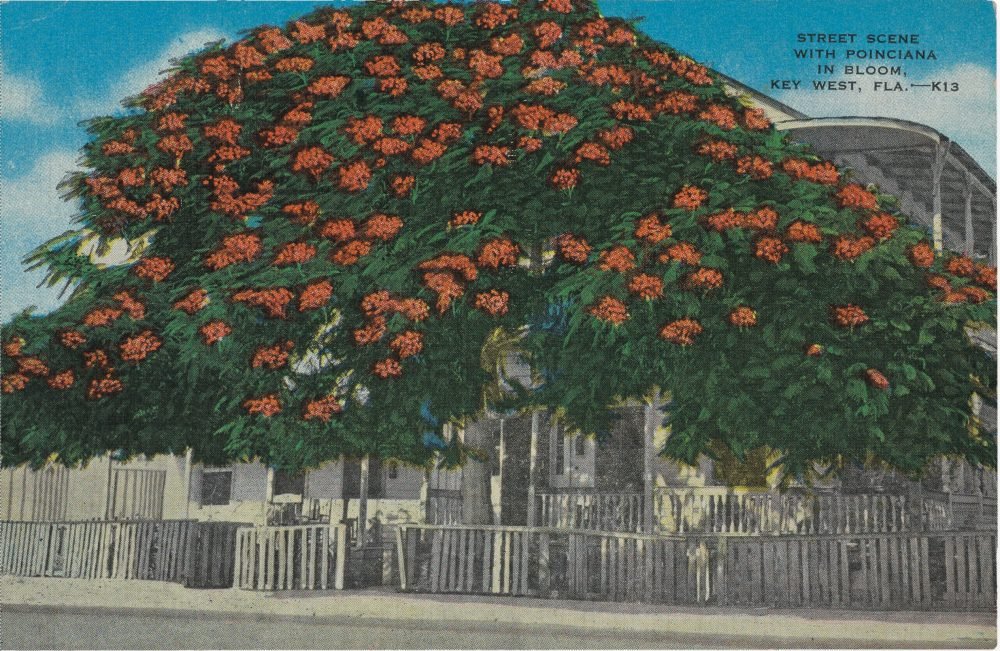
Images at top: (1 and 2) “Street Scene with Poinciana in Bloom, Key West, Fla.” Postcard from Elizabeth Bishop to Florence Bishop, September 7, 1957. Elizabeth Bishop Papers, Vassar College. (3, 4, and 5) Exhibition photos from 624 White St.

Billy Collins
Billy Collins Photo Credit: Nick Doll

by Marsh Muirhead

In her opening remarks last Thursday evening, board president Nancy Klingener referred to 19-time attendee Billy Collins as the paterfamilias of this, the 42nd annual Key West Literary Seminar.

The reason is obvious. Billy is universally beloved, profound yet accessible, and very, very funny. His dry wit and excellent timing are that of a very cerebral stand-up comedian. He has the ability to connect with each individual listener as if in a one-on-one relationship, talking, perhaps, to someone in the next room.

At his Sunday morning reading, “The Family and Poetic Claustrophobia,” I had the pleasure of sitting next to a woman new to Billy (her comments to her partner indicated as much). Her responses to the twenty plus poems that Billy read alternated between hearty laughter and the oooohing and aaaahhing of epiphany, at the surprising turns in the little journeys of poems that touch every aspect of human experience.

In the 122 pages of his latest collection, Water, Water, Billy regards Lord Byron, Amsterdam, Chet Baker, Adam, Plato, an astronaut addressing him from the space station (this actually happened), Emily Dickenson, Oriana Fallaci, Edward Hopper, Robert Frost, the Brooklyn Dodgers, Willie McCovey, and Mary Queen of Scots. Many of Billy’s most enthusiastic fans are older, boomers surely, who are able to appreciate the dazzling assortment of cultural and historical references, people who are likely good at Trivial Pursuit.

In the interest of transparency, I admit to being a devoted fan—I have all of Billy’s books (most signed) and I’ve attended every one of his Seminar appearances. And I was laughing and ooooohhhing with the same appreciation and pleasure as that woman sitting next to me this morning.


Marsh Muirhead is a retired dentist and pilot. He has been attending the KWLS since 1987. His work has appeared in Rattle, Southern Poetry Review, Poetry East, The Carolina Quarterly, Cutthroat and elsewhere. His commentaries are a regular feature on public radio KAXE in Minnesota. He has published two collections of haiku and teaches a class in haiku at the Studios of Key West.

Ayana Mathis, Lydia Millet, and Emily Raboteau
Ayana Mathis, Lydia Millet, and Emily Raboteau, Photo Credit: Nick Doll

by Katie Mitchell


On a morning when the world is indeed burning with flames too real to be a metaphor, Ayana Mathis, Lydia Millet, and Emily Roboteau sat down for a conversation entitled “The Radical Potential of Mothering: On Children and Building Worlds While the Earth Burns.” Roboteau opened the hour by reflecting on their time together the day before on a catamaran surrounded by miles of blue water, and as audience members, we deeply understood the dissonance she was referring to. We are, after all, in sunny Key West escaping for a few days of literary inspiration as the newsreel in the back of our minds details the climate change catastrophes all around us.

The central question of their talk was how to reckon with this dissonance and how to mother in a time when the future is so grave and uncertain. While their work spans different genres, all three women hold the same thread in their writing. Millet’s A Children’s Bible illuminates the angst a younger generation feels about the world they inherited while Mathis’s The Unsettled explores generational legacy and the cord that binds grief and hope. Roboteau’s essay collection Lessons for Survival: Mothering Against “The Apocalypse” weaves science, anthropology, and personal reflection to reveal the complexities of parenthood in the times we live in.

Ayana Mathis, Lydia Millet, and Emily Raboteau
Ayana Mathis, Lydia Millet, and Emily Raboteau, Photo Credit: Nick Doll

While each writer held her own perspective, together they reminded us that yes we live in uncertain times when the scope of climate disaster is beyond our comprehension, but nevertheless there are models of how to find resilience and how to mother those we love with nurture and care. They referenced Toni Morrison’s Beloved and the Indigenous Alaskan community Roboteau highlights in her essay collection, and as Mathis explained, through their experiences, we know that we can “create communities of deep love” despite the fires around us. We know this because others have done it before in communities plagued by forces determined to eradicate their humanity and value profit over human life..

As a teacher and a mother, I left the talk with pages of scrawled notes and a feeling of being both held and challenged. Perhaps mothering is not just a role we fulfill when we are in a family system, but as Roboteau reminded us at the end of the talk, “mothering is an ethic” and an act of radical care. To channel our anger, to roll up our sleeves and get to work, to imagine new worlds and possibilities beyond this one, and to remember that hope is an action and not just a feeling. These are the things motherhood requires of us, but more than that, perhaps that’s what our earth requires of us, too.


Katie Mitchell teaches English in a suburban Atlanta public high school school and strives to create a classroom environment where students can learn and grow, find their own voice through the written word, and use literature as a doorway to better understand the world around them. She also writes creative nonfiction, and her work often explores motherhood, grief, and love of place. She is a 2025 Teacher & Librarian scholarship recipient.

John Irving
John Irving
Photo Credit: Nick Doll

by Darren Chase


John Irving delivered the John Hersey Memorial Address to a rapt and appreciative audience Thursday evening. The Oscar- and National Book Award-winning author began his presentation on “The Bildungsroman and the Alternative Family” by acknowledging his debt to his heroes, Dickens and Melville. Like himself, he said, these authors were drawn to depicting unconventional family structures. According to Irving, a bildungsroman “is a genre that illuminates the psychological and moral development of the main character.” In Great Expectations, Dickens’ orphaned protagonist Pip finds a nurturing caregiver in his sister’s blacksmith husband, creating a loving family against all odds. Ishmael and his shipmates form a cohesive crew in Moby Dick despite the abuses of their tyrannical captain. In the manner of a classic bildungsroman, the forming and sustaining of these alternative family arrangements is a process that develops character and creates a compelling story.

Irving drew us further into the seminar’s theme of “family” through readings from his own work. From Melville, he quickly turned to his sixteenth novel, Queen Esther, in which the character of Dr. Larch, (previously appearing in Irving’s seminal novel, Cider House Rules) takes a more central role. Wilbur Larch, director of St. Cloud’s Orphanage, is sure that Thomas and Constance Winslow are the only parents who could possibly adopt the orphaned adolescent, Esther. There are two issues: The child is too old to be adopted by most families and she is Jewish. Irving read two sections of his novel that expound on this conflict. The first was an exchange between the prospective parents and the orphanage’s staff, a scene that highlighted the exceptionalism of Irving’s character. (She is “a special girl,” “loved and looked up to by all the girls,” a determined, spirited and dynamic presence.) The passage also conveyed Thomas Winslow’s principled nature. (He is “intolerant of intolerance,” refusing to engage with the town’s rampant antisemitism.) Dr. Larch bonds with the girl by listening attentively to her tell the story of her biblical name, engaging wholeheartedly with her nascent self-awareness. This interchange constitutes the beginning of yet another expedient, but meaningful surrogate family structure that catalyzes change in the young Esther and in her “family” of orphanage staff and adoptive parents.

The final chapter of Queen Esther is set in Jerusalem in 1981, when Esther is 76. As Irving expounded in his responses to the audience’s questions, he spends a great deal of time researching his subjects. The last time the author visited Jerusalem was in eighties. He returned in July of 2024, in his words, “to see again everywhere I was, now more than forty years ago.” He remembers Esther’s development from an “angry little girl who is three, almost four, when she was left at the orphanage” to a woman of 76 in the early 1980s. He ended his with talk with the words, “My characters come from the late nineteenth century and the twentieth century, but Esther’s story is as old as the Old Testament and the Hebrew Bible.” Thus, Esther’s formative journey is one that “illuminates the psychological and moral development” of not only the author’s subject, but the writer himself.

The resonant culmination to the evening came when Irving took two questions from the audience. He elaborated on his own background, his own bildung, if you will, describing how, by growing up in a boarding school among diverse schoolmates, and then living outside his country of origin as an adult, he has cultivated a sense of contentment with his own “outsiderness.” He spoke about how the process of engaging with people unlike himself was “a wonderful way to know that [I] don’t know the world.” In closing he said, “Foreignness is an intrinsic feeling for a writer. You’re already more of an observer than a participant, even before you know it.”


Darren Chase teaches ESL at New Design High, a public school in New York City. His writing has appeared in Pangyrus, Cagibi, Sisyphus, eMerge Magazine, The Red Noise Collective, Humans of the World and On the Run. His forthcoming novel is tentatively titled Robot Guru. He is a long-term member of Bruce Benderson’s writing workshop. He is a 2025 Teacher & Librarian scholarship recipient.

Jimmy Buffett on stage in February 1981. Photo by Susanne Hunt. (FloridaMemory.com)

Jimmy Buffett Sails On

Jimmy Buffett’s death at age 76 on the eve of Labor Day Weekend prompted a tremendous outpouring of news coverage and tributes from fans and others around the globe whose lives were touched by the iconic singer-songwriter, author, and entrepreneur.

Buffett’s impact on Key West is incalculable. Generations of Key Westers have come of age on an island that the world now knows as “Margaritaville,” and Buffett’s brand of low-key loafing and aspirational island living are inseparable from the island city where the Mississippi-born Buffett first discovered it all. As art imitates life and life imitates art, Buffett’s prodigal 1970s songbook gave fictional form to a Key West cast of characters and lifestyle he knew in his bones, while firmly establishing conventions that Key West residents and visitors have followed ever since.

Buffett was a literary powerhouse as well, one of only six writers, including Ernest Hemingway and John Steinbeck, to reach #1 on the New York Times bestseller lists for both fiction and nonfiction. He was an early champion of Key West Literary Seminar and had served on our honorary board of directors since 1987. Our organization, like so many others in Key West, is indebted to Jimmy for helping to put us on the map those many years ago.

As you might expect, Key Westers turned out in force to pay their respects over the long Labor Day weekend (some have suggested the holiday be renamed “Leisure Day” in Jimmy’s honor). Key West Mayor Teri Johnston ordered flags in the City to fly at half-mast, and a single loudspeaker was placed on the steps of City Hall, where it blared Buffett tunes all weekend long. On Sunday, nearly 10,000 people turned out to parade down Duval Street in Buffett’s honor.

For a look at Buffett’s legacy from the end of the road, check out KWLS board president Nancy Klingener’s report from Key West for the New York Times; Rob Smith-Martin’s personal recollection of the early days of the Margaritaville empire, “Remember When Margaritaville Was a Mom & Pop Shop?”; and, especially, his sister Lucy Buffett’s tribute in the Key West Citizen.

According to Lucy, “He didn’t care about resting in peace. The last words he whispered to me were, ‘Have fun.'”

Jimmy Buffett's 1989 thank-you letter to the Key West Library "for keeping me cool in those hot happy summers not so long ago." (Key West Library on Flickr.)
David Wolkowsky at Ballast Key in 1994. Photo by Timothy Greenfield-Sanders for L’Uomo Vogue.

Key West lost one of its defining figures with the death of David Wolkowsky on Sunday, September 23, 2018. He was 99.

Wolkowsky was a member of the Key West Literary Seminar board of directors from 1988-1991 and a member of its honorary board since 1992. But his impact on Key West and its literary and cultural scene was far greater than these official contributions. Among other things, Wolkowsky was a legendary host and matchmaker without peer, who brought an astonishing assortment of writers, artists, and “interesting people” together in the subtropical island city where his grandfather had arrived as a penniless immigrant following Key West’s great fire of 1886.

Wolkowsky’s annual writers’ party, held during the seminar each January, was a glittering affair at the penthouse apartment Wolkowsky built atop his father’s former Duval Street department store. A guest list of renowned writers mixed with celebrated artists, filmmakers, politicians, and A-listers from around the world, along with the local bartenders, tradespeople, fishermen, and friends for whom it was the most coveted social occasion of the year. Even more coveted was an invitation to Ballast Key, Wolkowsky’s private island, where he hosted friends in the heart of the 200,000-acre marine wilderness known as the Key West National Wildlife Refuge, far from the bustle and noise of the downtown district whose once-dusty streets he had known since childhood in the 1920s.

I was lucky to know Wolkowsky and count him as a friend throughout my adult life. From the moment I met him, in the winter of 2001-02, I was charmed by his unique combination of refined elegance and deep informality. I had returned to the Florida Keys that December after graduating from college and was drifting about, with vague ambitions of being a writer and an even vaguer idea of how to earn a living. My mom, who had known Wolkowsky from her time as director of the Seminar, suggested I call him and ask if he was looking for any help. I looked him up in the phone book and placed a call.

“Hello, Mr. Wolkowsky?,” I said, nervously.

“Call me David,” he said, deeply familiar and kind before even knowing who I was. “Who is this?” he asked, brusquely now.

“Hi, David, this is Arlo Haskell, I’m Monica Haskell’s son.”

“Arlo,” I was struck again by his familiar tone, and his distinctive, almost Mid-American accent, whose type I’d only heard in movies. “Yes, I was hoping you might call. How are you?”

I offered a brief recent history: graduated college, home again, looking for work. I told him my mom had said he might be looking for someone.

“She did?” David asked, seeming surprised. “Well, yes, I might. How would you like to come over for lunch on Friday?”

“Um, sure,” I said, “that’d be great.”

“Let’s say one o’clock, then, at my house. O.K.? Ten-fourteen Flagler.”

“O.K., great. One o’clock—” the phone clicked as David hung up—“on Friday. Thanks, David.”

I called him David ever after.

David's father and grandather, Isaac and Abraham Wolkowsky, ran a men's clothing store around the turn of the century. It appears at right in Mario Sanchez's "Old Island Days No. 23, 'Golden Era,'" shown here at David's home. Photo by Michael Adno.

Arriving for lunch that Friday, I entered the property through an ornate set of teak doors, removed from a Thai temple during the early 1980s, when David had been a partner in Kavanaugh’s furniture store, whose dusty storerooms full of strange, large, and wonderful eastern relics, I used to love to wander. Directly through these doors, which were set in the concrete block wall that hid his grounds from the passing public, was a swimming pool the size of which I’d only seen in hotels. On the left of the pool was a grand-seeming house, whose interior could partly be seen through the wall of sliding glass doors that fronted the pool.

No one answered when I knocked and called out, but the front door was standing open so I walked in. A single large room, with two sides of sliding glass and a high, vaulted ceiling, from which slowly whirring fans descended. The fans hanging through such volumes of space drew your eyes up, as in a cathedral, to the little windowed cupola that formed the apex of the room, where every surface seemed to overflow with fascinating items. On top of the grand piano were black-and-white photographs of Tennessee Williams, drinking and laughing in a Key West garden along with some glamorous-looking women and other men. Upon the table, a mound of reading material: the New York Times lay open, rifled through and obviously well-read, and dozens of books ranging from large-format coffee-table art books to biographies of historical figures. A striking wooden sculpture by the local artist Duke Rood—the vertical figure of a man descending headfirst—was situated among flowering orchids on a table at the center of the room, giving the impression that he he was diving, or had fallen, from a perch in that airy cupola. A drawing, signed “Picasso,” was on the back wall, near the porch, obviously neglected. There were a few Russian-constructivist-ish collages, and, scattered about, several of the colorful painted wood reliefs created by Mario Sanchez, a folk artist of rare talent and humor who had chronicled the Key West of David’s boyhood.

I found David in the middle of all this, sitting and talking on a white couch with his friend Tom Schmidt, who owned one of David’s favorite restaurants, the Rooftop Café. The three of us exchanged pleasantries and I noticed another man standing in the entryway to the kitchen, who seemed to be a little older than I was. He was dressed in white tennis shorts and a polo shirt, with white tennis shoes, white gardening gloves, and sunglasses, and he stood quietly in place, with his head and its artfully disheveled afro pitched slightly down.

“Arlo, this is Zach,” Zach raised his head and smiled beatifically, showing a mouthful of crooked teeth, two plated in gold. “He helps out here,” David said.

“Hi Zach.”

“Hello,” Zach said, and he seemed to float away on the word, smiling at some memory, of what I didn’t know.

“Perhaps you could give Zach a hand in the kitchen,” David suggested.

“Sure,” I said.

“Let me show you.”

I followed David into the kitchen and watched as he opened the refrigerator. Zach remained in his original position.

“We’re just going to have a little salad,” said David, “I buy this salmon salad from Publix, and here’s Boston lettuce. I like just a scoop of the salmon on a bed of lettuce, with a little olive oil. There will be three of us.”

“Sure, David. No problem.” As David left the kitchen, I saw my lunch invitation transform into an audition for a job I wasn’t sure I wanted.

“Zach, where are the plates?” I asked. “In the cabinet,” he said, indicating the corner, and smiled again, without moving from the spot where I’d first seen him.

I prepared, quickly and artfully, in the fashion of the restaurant line cook I had been off-and-on through college, three simple salad plates, drizzled with olive oil, topped with ground pepper, and garnished with a lemon slice. David stepped back into the kitchen at this moment.

“Arlo? Join us in the other room, won’t you?”

It was a test, I suppose, and everything seemed like a test for a while, but eventually I guess I passed, as that shift in the kitchen marked the beginning of my employment as David’s roaming man Friday and caretaker of his various properties.

Ballast Key, roughly nine miles west of Key West in the Key West Wildlife Refuge.

During the year I worked for David, my duties tracked his interests and eccentricities, mapping a social tableau that spanned from high to low. At night, I was his driver, delivering dinner guests that included U.S. Senator Daniel Patrick Moynihan and John Hersey’s widow Barbara Hersey, to whom David was deeply devoted, to and from dinner at the Rooftop Café. In the early morning, I accompanied him to Simonton Beach, where a group of homeless men slept in the shadows of the Pier House, the fashionable resort David had developed in the 1960s. At that first lunch with David, I had told him about my experience as a stonemason in upstate New York, and without exactly telling me, David had decided that I would build a stone retaining wall at Ballast Key, where storms and shifting tides had eaten away at the beach where his dear departed friend John Malcolm Brinnin had once sat and read the New York Times while the Gulf of Mexico lapped at his feet. There was plenty of limestone surrounding the island, David pointed out to me on my first visit there, and indeed there was. The fact that it was underwater at all but the lowest tide, and would require a great deal of hard labor to extract, went unmentioned.

David’s methods were inscrutable, but somehow, among the tall grasses of the sea oats and empty vodka bottles at Simonton Beach, offering $5 an hour plus room and board on his private island, he always found one or two men who said they were willing to put in a few good days’ work. In the afternoon, I ferried men whose names were Miles and Popeye, and whose weathered skin and full beards made them look older than they were, aboard the smaller of David’s two boats, which pitched and rolled uncomfortably in the current-driven chop of Northwest Channel, out to Ballast Key, where we established a work camp. Against the incoming tide and in the blazing sun, they worked with heavy iron bars to break jagged slabs of limestone from the shallow waters that surrounded the island and carry them in overloaded wheelbarrows to the beach where I was building the wall, piece by piece. Lunch was hot dogs and potato chips, the same again for dinner. Who knows what the men thought after the sun went down and they found themselves alone on this otherwise deserted island—a millionaire’s paradise and private retreat, or something wild and forbidding? Ballast Key always seemed a bit of both, and while Miles and Popeye returned for multiple engagements, it wasn’t for everyone. One morning, I found Rudy, a gentle, bearded man who lived as a hermit in the Maine woods in the summer, and in the Key West cemetery in the winter, desperate to “escape,” as he put it, holding a cardboard sign that read “Key West, Please!” as he waved frantically at passing boats. “I can’t take it anymore,” he told me, obviously shaken. I told him that everything would be ok, he was under no obligation to stay, and I took him back to Key West. I would see Rudy around town occasionally in the years that followed. Although the island’s black and glittering night had terrified him, he apparently remained charmed by the man who had brought him there. “How’s David?” he would ask me, and you could tell that part of him wished he could return to the island.

On the weekends, as my retaining wall slowly came together, I began ferrying more illustrious guests to Ballast Key, a Vanderbilt here, a Rockefeller there, and the ever-growing cast of dazzling writers among whom David always seemed most at home. Driving the 27’ Boston Whaler that David reserved for guests, I delivered Robert Stone to the island one evening as darkness fell, leaving him there, alone, to work on completing the manuscript that became the novel Bay of Souls. While navigating the shallow expanse of water known as “the lakes” that separates Northwest Channel from Ballast Key, I was introduced to Laurent de Brunhoff, co-creator of the Babar series of storybooks I had known as a child, and his brilliant wife, the writer Phyllis Rose, who would later help edit my first book. I met famed writer Judy Blume and her husband George Cooper, another couple David recruited to Key West and who in turn created its only independent cinema and its leading bookstore. I talked with Renata Adler, whose thick braid of white hair swayed in the heavy wind generated by the boat’s forward motion. I met Bill Wright, a writer whose charm at times rivaled David’s and whose friendship with him then spanned nearly forty years. So many people whose names and backgrounds dazzled me, either immediately or only when I eventually realized who they were, years later—guests from London, New York, South Africa, Paris, Rome. An endless, rotating cast of fascinating writers, shouting literary references and friendly gossip over the roar of the twin outboard motors, with David occupying the co-captain’s chair and smiling on at the scene he had designed and casted. At the island, David served them hot dogs and potato chips for lunch too.

David with his friend Sarah Benson, during a 2012 party at his penthouse above Duval Street. Photo by Nick Doll.

David loved people and conversation and he had a gift for making his friends feel wanted. When David phoned to invite you over for lunch, there was often no need to check your schedule. He meant lunch today, and that you should arrive within the next fifteen minutes if possible. When I could, I dropped everything to join him. When I had something that seemed more pressing, I declined and regretted missing the opportunity. I regret those missed opportunities still.

Once, in September of 2008, David phoned to invite me over as Key West was being lashed by the winds and rain of Hurricane Ike, which was churning along the southern coast of Cuba. A mandatory evacuation order was in effect, but when I arrived I found the house on Flagler un-boarded, and David the picture of ease, chatting leisurely on the phone with Bill Wright, who, since our first meeting at Ballast Key years earlier, had also taken me under his wing, surely with David’s encouragement. I followed David into the kitchen, where he removed two salads from the refrigerator that had been prepared earlier—Boston lettuce and Florida avocados, seasoned with olive oil, salt, and pepper. After we ate the salads, David prepared lamb chops on a George Foreman grill—they charred and filled the air with rich aroma as succulent juices sizzled on the electric heating element. David cooked them to perfection on the unlikely surface, utterly delicious. For dessert, David warmed two slices of pumpkin pie in the oven and served them with vanilla ice cream.

After lunch, David said he wanted to see the island—not “the island,” as he always called Ballast Key, but the one whose ascendant place in the national consciousness had led to his popular nickname in the press, “Mr. Key West.” We climbed into the car as the rain drove down and David, who had just turned 90, got behind the wheel. He drove to a house he was renovating on Von Phister Street, where we took advantage of a brief break in the rain to have a look inside. The new roof and windows were holding up nicely in the storm; there were no leaks and it was utterly quiet inside, without even the hum of electricity. Ike was his father’s name and I think the hurricane had made David nostalgic—for the man whose death had brought him back to Key West over a half-century ago (a 1962 obituary said Ike had “a strong sense for the absurd or ridiculous”), and for a Key West that he felt, at times, was changing from authentic to commodity.

“You used to meet them all the time,” David said, “newcomers, writers, interesting people. But no one comes anymore.”

After surveying the rising waters on Eaton Street, David drove me back to my house on Love Lane. I’d been fascinated by the twists and turns of our conversation, and all the bits of Key West history he had revealed, and I asked if I could do a formal interview with him at some point.

“I’ll be happy to help,” he said, “but I’m rather overexposed already. At first you know it’s fun, and everybody likes a little acclaim, but after a while it starts to upset the neighbors.”

As the years went by, David’s oldest friends seemed to pass away one by one. Some time after Bill Wright died in 2016, David told me that he had never expected to live so long. It was lonely, at times. I could see that. Arriving at a friend’s party, filled with people, he joined me on a couch at the edge of the crowd and surveyed the room. “Who are these people?” he asked. But of course everyone knew who he was, and soon his many admirers were crowding around, patiently waiting their turn to share time—that ineffably precious resource—with David.

Photo by Michael Adno.

David introduced me to and made me welcome in the fascinating world that was his. He opened doors that have helped define my life and career. Through it all, he kept me laughing with his inimitable sense of humor, by turns cryptic, campy, wry, self-effacing, and bold. Over the past two years, with David occasionally having difficulty talking, a flurry of handwritten notes came in place of the usual phone calls. On my 38th birthday, a postcard from Ballast Key, showing a small boat at rest on a pile of jagged limestone—“I still remember the Ballast Key stone wall of Arlo”—a teasing joke, since Hurricane Ike had largely destroyed the wall I built and shifted John Malcolm’s beach yet again. Another postcard arrived soon after I took over the directorship of the Seminar, one that showed David at the beginning of the construction of the Pier House, standing in shorts and a t-shirt with the old Tony’s Fish Market hoisted high on blocks—“Arlo, it’s so great to have you where you belong. So hello, Dolly.” David even started emailing, surely one of the very few times someone opened a Gmail account at the age of 96. A stream of jokes and references followed from his iPad. There was a YouTube clip of Marlene Dietrich in concert, a selfie of David with someone’s dog in the driver’s seat of his vintage Excalibur (this to congratulate me for a talk I had given, saying “you don’t need a pup to charm an audience”), a simple photo of flowers on a table in that cathedral-like living room of his, and another selfie with his old friend, Mickey Wolfson, whose illustrious family history in Key West tracked David’s to the 1880s. “Wolf wolf,” he typed, and I could almost hear him laughing.

When I published a book last year that explores the roots of Key West’s Jewish community and the role played by David’s grandfather in its founding, David took on a new role as my biggest fan. “You have recreated Key West — a pioneer feast,” he wrote. “Even Tennessee Williams would be proud.” He bought dozens, maybe more than a hundred copies, throwing them over fences into the yards of his friends like a newspaper delivery boy. “Meanwhile I have raided Books & Books of Arlo,” he wrote me last winter, “not because I’m in it, but because I am not in it enough.”

David and I at a yard sale in 2013 — he ended up with the hat. Photo by Ashley Kamen.

Key West will go on, and David’s vision for it will continue to inspire me to work toward a more interesting island. But there will never be enough David here again. I will miss him a great deal.

One more memory. When Ashley and I were planning for our wedding in the spring of 2012, we knew exactly where we wanted to throw the party. There are a lot of beautiful old homes and gardens and venues in Key West, but there was only one place that, when you were there, you reliably felt that you didn’t want to be anywhere else, and you didn’t want the night to ever end.

“David’s penthouse,” Ashley said.

“But it’s David’s penthouse,” I said. I couldn’t imagine that our party could happen in a place that was so thoroughly David. And I couldn’t imagine asking him for something so personal. During the year I worked for David, there was an expression, a single word, actually, that he would deploy if you asked a question that was too personal, or if you said something within the hearing of someone who shouldn’t hear what you were saying.

“Seven,” David would say. And, only the very first time he said it, by way of explanation, “that’s a seven. Seven means don’t.”

I was sure that asking David if we could throw a party at the penthouse was a seven. But Ashley convinced me, and I picked up the phone.

“Hello,” David said.

“Hi David, it’s Arlo. Ashley and I are planning our wedding for the spring. We’re going to get married at the end of White Street Pier, and we’re looking for a place to hold the reception.”

“O.K.” he said, and paused.

“We thought of the penthouse. And we were wondering, I don’t know if you ever, if you would ever consider renting it to—”

“I wouldn’t,” David replied sharply. I knew it. It was too personal, too private a thing to ask. I felt my cheeks flush as I struggled to think of how to continue the conversation.

“O.K.,” I said. “I thought so. I just thought I’d ask—”

“I wouldn’t rent it,” he said now. “But I’d like for you and Ashley to have your wedding and spend the night there. As my guests. Of course.”

A toast to David on our wedding night, 2012. Photo by Nick Doll.

Friends and relatives from around the country flew in to join us and dozens of local friends “on the roof” at David’s penthouse. It rained all day, but the clouds broke before the ceremony to reveal a dazzling sunset. As we arrived at the party, stars were visible above the glow of Duval Street. David stayed home at Flagler Avenue that night, but his gift was all around us. Out-of-town guests were in awe—this is Key West? Where are we? Key West friends felt the same. They’d only ever heard of this place, and now they knew why. The handful of mutual friends of David’s and ours that attended, including a number of the writers I’d first met on the boat rides to Ballast Key, seemed impressed and proud. They had known me when. Now here I was with Ashley on our wedding night, a night that only David could have made possible, filled with the glamour that only David possessed.

I phoned David the next day to say thank you. “Don’t mention it,” he interrupted, as I tried to find the words to tell him how much it had all meant to us. “Let’s have lunch sometime soon.”


Arlo Haskell is executive director of the Key West Literary Seminar and author of The Jews of Key West: Smugglers, Cigar Makers, and Revolutionaries (1823-1969).


More about David Wolkowsky:

The Elizabeth Bishop House came alive in last June with our Young Writers Studio. It was a week filled with sunshine and adventure, laughter and popsicles, and a lot of great writing. Teachers Nick Vagnoni and Kelly Smoot led ten local teens through an odyssey of inspirational hubs, from the Florida History Room at the public library, to the Dry Tortugas, to the home of our annual Seminar: the San Carlos Institute.

The Bishop House buzzed with the sound of 1940s records, writing exercises around tropical fruits grown in our own backyard, and lively afternoon workshops with Distinguished Visiting Writer Jennine Capó Crucet. These young writers astounded us with their talent at the final reading on Friday, generously hosted by Books & Books at the Studios of Key West. Keep an eye out for great things from these young writers in the future!

A look at the week …

Tropical Fruit-Tasting & Sensory Description

With their endless variety of shapes, colors, smells, and tastes, tropical fruits are exciting and distinct, beautiful and strange, and fun to try to capture in words. Here, Rylan Owens, Maceya Carey, and Summer Bailey do just that. The source materials for this exercise included mangos, bananas, and cocoplums grown in the backyard of the Bishop House; and mamey, soursop, lychee, and passionfruit from the farmlands of South Florida’s Redlands. Download the lesson here, which can be adapted for whatever fruit is in season where you are.

Historical Studies: Hemingway and the Key West Citizen

Teacher Nick Vagnoni (center) leads young writers in a discussion of Ernest Hemingway’s “Who Murdered the Vets,” a scathing account of government mismanagement before the 1935 Labor Day Hurricane. Resources including the Key West Citizen’s day-by-day reporting on the storm add local historical context to the literary devices Hemingway employed to craft his work.

Contemplative Writing at the Elizabeth Bishop House

Participants like Isabella Grodzinski (sitting near the garden fountain) and Maceya Carey made use of the Bishop Garden throughout the week to read, write, and reflect independently on their work before and after focused sessions in the classroom. Filled with native plants and tropical fruit trees, the space offers equally fertile ground to young minds at work.

Daily Adventures

Young writers from three local high schools got to know each other during their literary adventures in Key West and beyond. Images (top to bottom): Jayla Hobbs and Sophia Zeledon pose before touring the historic San Carlos Institute; Isabella Grodzinski takes a break from writing at Fort Zachary Taylor State Park; Alena Tralenko enjoys a fresh mango from the Bishop Garden as part of a sensory writing prompt; Summer Bailey and Sophia Zeledon study the ocean’s color changes with director Arlo Haskell as they leave Dry Tortugas National Park; participants tour the interior of Fort Jefferson at the Dry Tortugas National Park.

Public Reading at Books & Books

The week ended in celebration with a public reading hosted by Books & Books at the Studios of Key West. Distinguished visiting writer Jennine Capó Crucet shared an excerpt from her latest book, Say Hello to My Little Friend, alongside the work of our young writers. Group photo from left to right: Jayla Hobbs, Sofia Zeledon, Dieunyssa Azard, Maceya Carey, Alena Tralenko, Jennine Capó Crucet, Isabella Grodzinski, Summer Bailey, Rylan Owens, and Kristian Kearins.

The year so far has been busy and productive for the KWLS team. We had a hugely successful Seminar in January with “Pay Attention! The Novel.” You can now listen to all the audio and review our 2026 event coverage online here. You can also view many past KWLS authors, including Robert A. Caro, Margaret Atwood, Jamaica Kincaid, and John Irving, dating back to 2017 on our YouTube channel.

Our Elizabeth Bishop House & Garden was recently recognized by the Historic Florida Keys Foundation with its highest honor for historic preservation. The Bishop Garden is lush and growing and is is open to visitors weekdays from 10-3. Executive Director Arlo Haskell offers a tour of the gardens each Wednesday at 8:30 am.

Our first poetry workshop at the Elizabeth Bishop House ran recently with a full class taught by multi-genre author Rosalind Brackenbury. Poetry is the theme of our 2027 Seminar, and it’s not too late to register.

Please see below for the latest news from our alumni. Congratulations to all!

Support local & independent booksellers! Purchase any book highlighted here from Books & Books @ The Studios of Key West and get a 20% discount. Use code “KWLS27” at checkout.

featured achievements

Lisa Lee’s debut novel, American Han, was published on March 31 by Algonquin Books.The story follows a fractured Korean America family as they are forced to confront the costs of their pursuit of the American Dream after their son, a former tennis prodigy turned police officer, goes missing.

“A beautiful, important novel that will leave a mark,” says Percival Everett. Order here. (2023 Emerging Writer Award Winner)

emerging writer award winners

Pritha Bhattacharyya’s short story, “The Trouble with Brown People” was published in the summer 2025 issue of the Kenyon Review. Bhattacharyya was shortlisted for the 2025 Granum Foundation Prize and was awarded the 2026 Germaine Poliakov Fellowship for a residency at VCCA Moulin à Nef in Auvillar, France. (2024)

Joshua Bodwell’s essay “And I Never Looked Back” appeared in the Los Angeles Review of Books in January. The longform piece traces the L.A. years of Charles Bukowski’s publisher, Black Sparrow Press, and its passionate founder, John Martin. (2015)

Scott Brennan’s poems have recently been published in Quarterly West, North American Review, River Styx, Grist, and Cimarron Review. (2013)

Melanie Pappadis Faranello won the Donald L. Jordan Prize in Literary Excellence. Her debut story collection, Everybody Needs Something, was published in March by Columbus State University Press, distributed by University of Georgia Press. (2022)

Kristen-Paige Madonia’s fiction is forthcoming in Alaska Quarterly Review and has recently been published in Literary Mama and Boulevard Magazine. She previously published two young adult novels with Simon & Schuster and is now at work on a literary novel exploring the cost of caregiving and keeping secrets in a marriage. (2008)

Erika Higgins Ross is working with Travis Lee Russ (Hilton Als 2025/ Marie Howe 2024), Artistic Director of Life Jacket Theatre Company, to produce StorySLAM, in which a group of storytellers from the Berkshires will be selected to tell true tales on stage at the Adams Theater and The ’62 Center for Theatre and Dance at Williams College in August. Locals can learn more and apply here. (2024)

writers in residence

Rachel Beanland’s novel, The Half Life, will be published in July by Simon & Schuster. Set in the 1970s on the Sardinian island of La Maddalena, it follows a woman forced to choose between her devotion to her new husband, an officer in the Navy’s Nuclear Propulsion Program, and her growing loyalty to a group of Italian scientists and activists who help her see the high cost of American exceptionalism in the atomic age. (2023)

Vanessa Frances’s debut novel, Orange Island, will be published next month by Red Rook Press. (2025)

Silas House is the 2026 winner of the Southern Book Prize in Nonfiction for his poetry collection, All These Ghosts. He previously received the 2023 Southern Book Prize in Fiction. House is a 2026 inductee into the Kentucky Writers Hall of Fame. His new novel, The Tulip Poplars, is a gay love story set in Appalachia and New York City and will be published by Algonquin Books in October 2026. His picture book, That Dog Won’t Hunt, will be released by Candlewick in Spring 2027. (2023/ 2018)

James Davis May was selected for the 2026-27 Amy Lowell Travelling Poetry Scholarship, which provides the recipient with funding to live outside North America for one full year. (2023)

Eliezra Schaffzin was awarded a Miami Individual Artists grant, which supports her while working on a novel and collaborating on a multimedia project with a South Florida-based artist. (2024)

writers’ workshop fellows

J.R. Fenn’s chapbook Tiny Vessels won the Masters Review Chapbook Open and is available now from Red Mare Press. “To read these seventeen gem-like dispatches from a dreamlike world,” writes George Saunders, “is to receive a lovely condensed version of what life on earth is like, and to be blessed with a feeling full of fondness and of longing for a kinder, more natural world.” (Marie Myung Ok Lee 2017)

Rachel Purdy’s essay “The Many Lives of Betty Mae Tiger Jumper” was published in the collection Literary Floridas: Essays on a Wild Peninsula Imagined, which explores the strange, unconventional, and often surreal landscape of Florida in literature. Her essay focuses on the storytelling tradition of the Seminole Tribe. (Fernanda Eberstadt 2020)

Sarah Sorensen’s poetry chapbook Light Splits Down the Wolf’s Tooth was recently published by Bottlecap Press. (Madison Smartt Bell 2018)

Carissa Welton, author of the middle grade novel Beneath the Surface, is launching a three-month book tour that will include twenty appearances in more than ten cities, leaving from her home state of Michigan and traveling all the way to Key West. (Malinda Lo 2025)

Arida Wright will become the Key West Poet Laureate 2026-2028. A ceremony for her inauguration will be held at City Hall on April 7, with a celebration to follow. (Tyehimba Jess 2023)

writers’ workshop students

Justine Busto was a finalist for the Doris Betts Fiction Prize from the North Carolina Writers’ Network. One of the stories she submitted was workshopped at KWLS with Charles Baxter. The other, “Espejo Májico,” will be published in the North Carolina Literary Review this fall. (Charles Baxter 2026/ Andre Dubus III 2025)

Jen Dary recently published her debut memoir, I Believe in Everything: A Memoir of Motherhood, Illness, and Magic. Washington City Paper cited it as one of the top books to read in 2026. She is currently on a book tour in New York City, Philadelphia, Baltimore, Boston, and more. Follow along on Instagram at @jendarywriter. (Matt Bell 2024)

Susannah Felts’s second novel, The Come Apart, will be published by Triquarterly Press in June. (Lauren Groff 2020)

Pamela Gay’s short story collection Micro-Stories will be published this year by Finishing Line Press. (Dani Shapiro 2017)

George Guida’s memoir, The Walking Amoeba, will be published by Bordighera Press this year, and a collection of poems, The Fulfillment Center, is forthcoming from Foothills Publishing. (Rowan Ricardo Phillips 2018)

Fran Hawthorne’s third novel, Her Daughter, was recently published by Black Rose Writing. (David Heska Wanbli Weiden 2024)

Michael Hayes recently published a poetry collection titled 81. (Cornelius Eady 2023)

Dev Jannerson was a 2025 Lambda Literary Fellow in Young Adult Fiction. (Liz Moore 2022)

Susan Long’s short story “John-John” was published in the Spring 2026 edition of Litmosphere. She is currently working on a collection of stories called Dreams of Appalachia–Take Me Home. (Madison Smartt Bell 2018)

Lael Mohib’s short story “The Whole Picture” was recently published as a Gulf Coast of Florida Feature in Magazine1. The story is from her short story collection titled Bilagaana. (Charles Baxter 2026/ Andre Dubus III 2025)

Lisa Slage Robinson’s debut short story collection, Esquire Ball, Stories from the Great Black Swamp, was recently published by Black Lawrence Press. These linked stories draw readers into lives defined by crime and consequence in the rugged, mythic landscape of Northwest Ohio. “Robinson writes the human condition with terrific sensitivity and surprise. Esquire Ball is a marvel,” writes Laura van den Berg. Three of the stories were workshopped at KWLS and two of the three have been published in literary magazines. (Jonathan Escoffery 2024/ Laura van den Berg 2022/ Luis Alberto Urrea 2020)

Julie Savitch’s memoir, My Other Kids: A Memoir of Child Advocacy and the Power of Showing Up will be published by She Writes Press in April. (Paul Lisicky 2024)

John E. Simonds’s fifth collection of poetry, Catching My Drift: Flames, Floods and Flowing Decades, was recently released by Outskirts Press. He turned 90 on July 4 and continues writing, submitting, and reading his work with online groups in Houston; Chicago; Honolulu; Plano, Texas; and Telluride, Colorado. (2019 Greg Pardlo/ 2018 Lisa Zeidner/ 2017 Rowan Ricardo Phillips/ 2015 Mark Doty/ 2014 Daniel Menaker/ 2013 Billy Collins/ 2012 Dara Wier)

teacher & librarian award winners

Amy Clark’s research on southern dialects and her podcast, “Talking Appalachian,” were featured in the Atlantic article “The Last Days of the Southern Drawl” by Annie Joy Williams. Her forthcoming book about disaster ballads and the famed music trio the Carter Family was awarded a grant by Virginia Humanities and will be published in 2027 by the University of Virginia Press. (2018)

Rachel Knox’s first book, Anywhere Else: Essays on Florida, was just published by University Press of Florida. It’s a memoir of growing up in Florida interwoven with cultural reflections of the state, revealing the complex truths of life as a Floridian. (2024)

Karen Parkman’s debut novel, The Jills, about a Buffalo Bills cheerleader who will stop at nothing to solve the disappearance of her best friend and teammate, was published by Ballantine Books in February. (2019)

Jo Boggess Phillips was inspired by her Seminar experience to secure funding to bring author Margaret Peterson Haddix to two middle schools last December. It was a fantastic day for students and staff! (2025)

photo by Nick Doll
Nicholas Boggs. Photo credit: Nick Doll

by Thomas Edward Frank

One of the most thrilling moments of any KWLS session is hearing first-hand from an author who has written an instant classic. Such was Nicholas Boggs discussing his new acclaimed biography of James Baldwin.

Boggs exuded an infectious passion for Baldwin: his writings, speeches, personal life, and historic context. As Boggs made clear in telling the story of his passion, he has been immersed in Baldwin lore from childhood–with a father who was a civil rights attorney, on through his education at Yale, Columbia, and American University. Baldwin has been the focus of Boggs’s entire writing career, and his comprehensive and insightful knowledge of his subject captivated the audience.

From Baldwin’s unforgettable eyes to his discovery of his speaking voice to his life as a gay man–something largely ignored or hidden in public perceptions–Boggs offered each keen detail that evoked Baldwin’s character. Boggs related his many years of archival work, his extensive interviews with those who knew Baldwin, and his travels to significant sites. Among many revelations arising in his research was a fresh view of Baldwin’s later life, not as a lonely, isolated, and forgotten man, but as a lively, sociable, intellectually active friend to many. In short, Boggs demonstrated what happens when a determined writer uncovers material that overturns assumptions–that were based in the first place on ignorance of that material.

The result is a massive tome that I cannot wait to read, having always been fascinated myself with this eloquent and often elusive man. Something that really struck me, though, is how unassuming Nick Boggs is, how modest in lecturing and open to conversation, how almost innocent in his accomplishment he still is. I am so grateful that I got to hear him and visit with him in Key West.


Tom Frank taught at both Emory University and Wake Forest University. After a career of academic writing and a lifetime of watching English language degenerate into puffery and gibberish, he composes poems as a necessary and evocative way of saying more with less.